
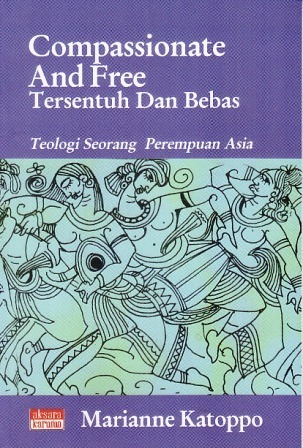
- Title: Compassionate and Free
- Author: Marianne Katoppo
- Archive Type: Book
- Published: 1979 (English)
- Publisher: World Communion of Churches, reprinted by Wipf & Stock
- Translated: 2007 (Indonesian)
- Available File(s): Photo(s)
- Keywords: Marianne Katoppo, Compassionate and Free, Asian woman theology, Marian theology, liberation theology, eucharist, salvation, European theology.
- Link: https://wipfandstock.com/9781579105228/compassionate-and-free/
Compassionate and Free: An Asian Woman’s Theology (1979) is the most famous book in the field of theology ever written by Indonesian novelist and woman theologian, Marianne Katoppo. She writes this book because “[f]or a long time, theology has been ‘European theology’; and for many people, ‘to be Christian’ meant being a ‘European Christian'” (v). To think beyond, she writes an effort “toward an Asian woman’s theology.” Although the is influenced by feminist thinkers, she does not use the term because it has been loaded. The main question of the book is: How do Asian women encounter God?
The book consists of 5 chapters. In “I. Woman as the Other,” she describes how women have never gotten any place in the global theological conversation by first delineating her own identities as Asian, Christian, and woman. “To be the Other was an alienating experience” (5). However, she disrupts the typical (Levinasian) understanding of “the Other.” “Yet for Katoppo,” as Indonesian woman theologian Septemmy Lakawa describes, “since the other is not just the discriminated one, we [women] must claim our own otherness.” She also recalls some memories of her father, Elvianus Katoppo, a historian, educator, and former Indonesian Minister of Education. Her father told her that “Marianne” was a popular name in the French Revolution.
In Ch. II, she revisits the common men’s antagonism in women’s liberation. She claims that women’s liberation is also man’s liberation. The reason is that the indicator of subordination is not simply sex. There are others, such as language (12). In this chapter, she also uses R. A. Kartini‘s ideal image of a woman as a “fully liberated human being”–while also critiquing the over-publicity of her European education–to deconstruct Marian theology (16-24).
In Ch. III, she discusses how the position of women is worsen by the socio-political realities in Asia, accusing the “Mammon” as the “enemy within” Asian community. This chapters includes some case studies on women in Indonesia, such as in education, political participation, rural space, the case of prostitution, and rape.
Ch. IV suggests some “theological motifs” that escape from sexist language. However, what is important in women’s liberation first and foremost is that women rise against the subjugation of all people. Using feminist discourse on the manly language to refer to God, Katoppo reminds the readers that the issue is not the “male-female” polarization, but rather between the “righteous” and the “wicked.” She also notes how in the primal religions in Asia always, people worshiped their ancestors, not just the male father. Therefore, “forcing people to relate to an all-male Trinity is oppression” (73). Thus, the feminine notions of the Holy Spirit, Mary, hokmah, and shekinah, are important for imagining how Asian women think of God.
Ch. V discusses two theological loci in relation to liberation: eucharist and salvation. For Katoppo, the origin of eucharist must be read in its truest context, that is, when Jesus “within 48 hours … was dead, killed by the oppressive social structures he sought to liberate people from” (82). On salvation, Katoppo recalls that in the perspective of liberation theology, salvation does not mean leaving and abandoning the world we are leaving. The Asian outlook on salvation is “closely related as it is to the experience of life in the mother’s womb” whose struggle and effort are to ensure the continuation of life (83).
This book has been overlooked before it was revisited and regarded as one of the earliest Asian woman (or womanist) theologians. It is cited in the works of currently prominent Asian woman and postcolonial theologians, such as Chung Hyun Kyung’s Struggle to be the Sun Again, Lisa S. Cahill’s Sex, Gender, and Christian Ethics, Kwok Pui Lan’s Postcolonial Politics and Theology, Grace Ji-Sun Kim’s The Grace of Sophia, and others.
Photo(s)


Source(s)
- Marianne Katoppo, Compassionate and Free: An Asian Woman’s Theology (Eugene, OR: Wipf & Stock, 1979).
- Septemmy E. Lakawa, “Tokoh 4: Henriette Marianne Katoppo.” Jakarta Theological Seminary 85th Dies Natalies General Lecture, August 28, 2019, https://www.youtube.com/watch?v=DqPIUNF4EDs.
Written by Abel K. Aruan (November 11, 2024); Edited by Abel K. Aruan (January 7, 2025).