
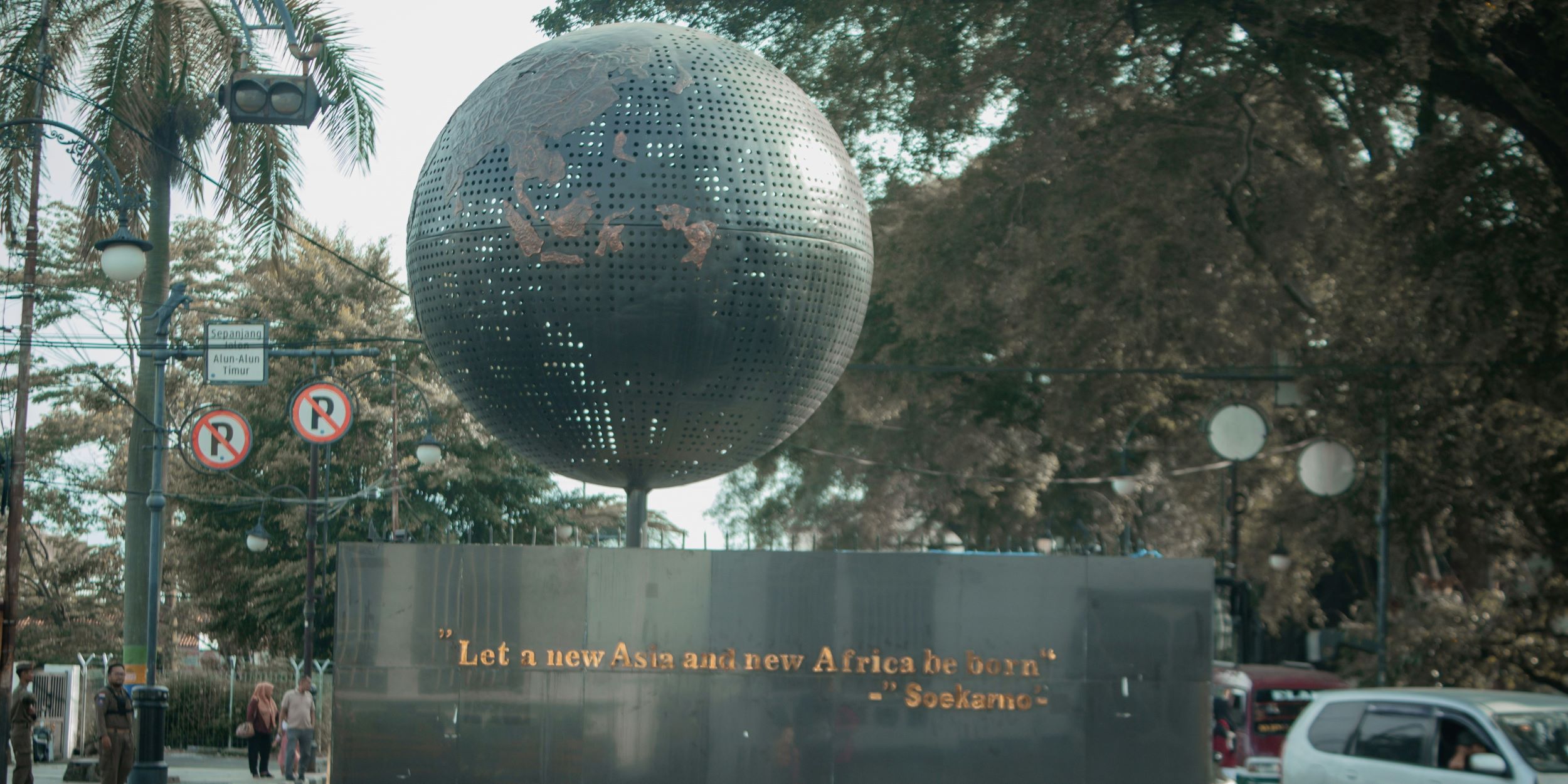
- Author/Institution: Soekarno (Koesno Sosrodihardjo), First Indonesia’s President
- Archive Type: Speech
- Date Published/Inaugurated: April 18, 1955
- First Publisher: Ministry of Foreign Affairs, Republic of Indonesia
- Archived by: Luxemburg Centre for Contemporary and Digital History
- Language: Bahasa Indonesia
- Available File(s): pdf.
- Keywords: Asia-Africa Conference, Bandung Conference, coloniality, decolonial thought, epistemic delinking, religion, Soekarno, secularism.
- Link: https://www.cvce.eu/en/obj/opening_address_given_by_sukarno_bandung_18_april_1955-en-88d3f71c-c9f9-415a-b397-b27b8581a4f5.html
Bandung Conference or Asia-Africa Conference in 1955 has been commonly considered the geopolitical origin of “decoloniality” or “dewesternization,” where people and the majority of global leaders attempted to go “beyond capitalism and communism” (Mignolo 2011, xii, xiii). Afterward, the term “the spirit of Bandung” was also used to refer to a similar spirit of decolonization, which rejects assimilating to any imperialistic power. Although leaders from five sponsoring countries (Burma, India, Indonesia, Pakistan, and Sri Lanka) should be acknowledged, it is important to highlight Soekarno‘s opening speech in regard to identifying the role of this conference in the issues of religion, ecology, and coloniality.
Titled later on by Roeslan Abdulgani, “Let a New Asia and A New Africa Be Born!,” the speech is opened with gratitude to all stakeholders who have made the conference possible, including the “forefathers” and “the invincible spirit of those who went before us.” He highlights that all the gathering participants are now “the masters in our own house” or “free people,” collectively and unavoidably trying to deal with the questions of “the life or death of humanity itself,” as a part of the “duties of independence.” A similar question and duty emerged after Indonesia, in 1945, achieved its self-determination. “We knew,” he goes, “how to oppose and destroy [the colonial powers]. Then we were suddenly confronted with the necessity of giving content and meaning to our independence” (p. 3).
Having achieved independence, all these countries, for Soekarno, are still threatened by fear.
Yes, we are living in a world of fear. The life of man today is corroded and made bitter by fear. Fear of the future, fear of the hydrogen bomb, fear of ideologies. Perhaps this fear is a greater danger than that danger itself, because it is fear which drives men to act foolishly, to act thoughtlessly, to act dangerously (p. 4).
This is the fear from which all participants must be liberated. Calling all the participants to be “united by more important things than those which superficially divide” them, Soekarno prevents himself from falling toward the logic of sameness by declaring that the commonality between them is a commonality of resistance (of work, rather than of identity): “a common detestation of colonialism,” “a common detestation of racialism,” and “a common determination to preserve and stabilize peace in the world” (p. 4).
Throughout, Soekarno also reminds the delegates that colonialism appears not only “in the classic form” which Indonesia, and other countries, knew in the past, by addressing some forms that decolonial scholars today have referred to as “coloniality of power,” that is, in the language of Nelson Maldonado-Torres, after Anibal Quijano, the “long-standing patterns of power that emerged as a result of colonialism, but that define culture, labor, intersubjective relations, and knowledge production well beyond the strict limits of colonial administrations” (Maldonado-Torres 2007, 243).
Soekarno asserts,
Colonialism has also its modern dress, in the form of economic control, intellectual control, actual physical control by a small but alien community within a nation. It is a skillful and determined enemy, and it appears in many guises. It does not give up its loot easily. Wherever, whenever, and however it appears, colonialism is an evil thing, and one which must be eradicated from the earth (p. 4).
Soekarno’s speech predates some more thorough interrogative analyses of coloniality, such as presented by Anibal Quijano and Enrique Dussel, who both accuse “eurocentrification” as the virtual process of privileging Europe’s “geocultural identity” as superior among the global network of power. More than a physical presence, similar to what Soekarno addresses, the colonial regime preserves its superior position through an epistemic privileging, where the knowledge of the Other is deemed less intellectual or even exterminated (Dussel 1995; Quijano 2000; see also Grosfoguel 2013).
Accordingly, in this speech, Soekarno does what Walter Mignolo later calls, “epistemic delinking” (desprendimiento), namely, a sort of strategy or politics in how thinkers or leaders grapple with the reality of Western (and also communist, in Bandung Conference’s case) knowledge production by distancing themselves from the assumption that the colonized or formerly colonized bodies do not have the power to create discourse. This epistemic delinking, then, “brings to the foreground other epistemologies” that have been subtly or violently disregarded (Mignolo 2010). “Have no doubt of the omnipotence of a free people” (p. 6), says Soekarno after French revolutionary journalist Camille Desmoulins.
Another thing worthy to highlight in this speech is Soekarno’s appeal to the role of religion. In the context of reclaiming the diversity among Asian and African nations, he reminds the delegates that the conference “is not to oppose each other.” Rather, it is “a conference of brotherhood,” where all differences and particularities are not reduced to “clubs” or “blocs,” but instead to be brought to the table in order to show and “to impress on the world that it is possible to live together, meet together, speak to each other, without losing one’s individual identity” (p. 7), including one’s religion.
Asia and Africa, in fact, have a greater diversity of religions and faiths and have successfully lived with all those religions because they are “the classic birthplaces” of faiths and religions before they are brought to other parts of the world. Religion, furthermore, becomes a strength instead of a disadvantage due to its true “message of tolerance” and its “insistence on the observance of the principle of ‘live and let live'” (p. 7). In other words, religion can be a tool instead of an obstacle to the decolonial project.
Soekarno’s appeal to religion is crucial to highlight because, as noticed by many religious scholars, like An Yountae, “The substantial role religion has played in the historical trajectory of modernity/coloniality is obscured by the hegemonic installation of secularism as the ideology dictating the Western epistemic framework” (An 2000; emphasis added).
Photo(s):

Source(s):
- Abdulgani, Roselan. The Bandung Connection: Konperensi Asia-Afrika di Bandung tahun 1995. Jakarta: Dirjen Diplik Kemenlu RI, 2011.
- Dussel, Enrique D. The Invention of the Americas: Eclipse of “the Other” and the Myth of Modernity. Translated by Michael D. Barber. New York: Continuum, 1995.
- Grosfoguel, Ramón. “The Structure of Knowledge in Westernized Universities: Epistemic Racism/Sexism and the Four Genocides/Epistemicides of the Long 16th Century.” Human Architecture: Journal of the Sociology of Self-Knowledge 11, no. 1 (2013): 73–90.
- Maldonado-Torres, Nelson. “On The Coloniality of Being: Contributions to the Development of a Concept.” Cultural Studies 21, no. 2-3 (March/May 2007): 240-270. https://doi.org/10.1080/09502380601162548
- Mignolo, Walter D. “Delinking: The Rhetoric of Modernity, the Logic of Coloniality and the Grammar of de-Coloniality.” In Globalization and the Decolonial Option, edited by Arturo Escobar and Walter D. Mignolo, 303–68. London New York: Routledge, 2010.
- “President Sukarno Opening Speech at, the Bandung Conference, 1955, Indonesia.” Timescape Indonesia. May 19, 2023. https://www.youtube.com/watch?v=DRIch247vb8
- Sukarno. [Address given by Sukarno (Bandung, 18 April 1955)]. [online]. In: Asia-Africa speak from Bandung. Jakarta: Indonesia. Ministry of Foreign Affairs. 1955. pp. 19-29. Consulted on 22-08-2024. Retrieved from https://www.cvce.eu/s/3o.
- Quijano, Aníbal. “Coloniality and Modernity/Rationality.” Cultural Studies 21, no. 2–3 (March 2007): 168–78.
- ———. “Coloniality of Power, Eurocentrism, and Latin America.” Translated by Michael Ennis. Nepantla: Views from South 1, no. 3 (2000): 533–80.
- Yountae, An. “A Decolonial Theory of Religion.” Contending Modernities. University of Notre Dame. February 28, 2020. https://contendingmodernities.nd.edu/decoloniality/a-decolonial-theory-of-religion/